Market
Shall We Repeal the Laws of Economics – Part III
Market / Real Estate
A New Chapter for Real Estate
We believe we may be in the early stages of a real estate recovery.
Key Points
- We believe we may be in the early stages of a real estate recovery.
- A range of factors are supporting this recovery, from strong demand to supply constraints to a positive lending environment.
- We believe that this may be an opportune time to invest in private real estate, and that the recovery may offer strong investment opportunities and potential benefits for the next several years.
Backed by Gains: A Real Estate Recovery
We believe we are in the early stages of a real estate recovery, one that offers strong investment opportunities for the next several years. Real estate is arguably seeing more tailwinds than headwinds currently, and the current market environment may present opportunities for long-term investors.
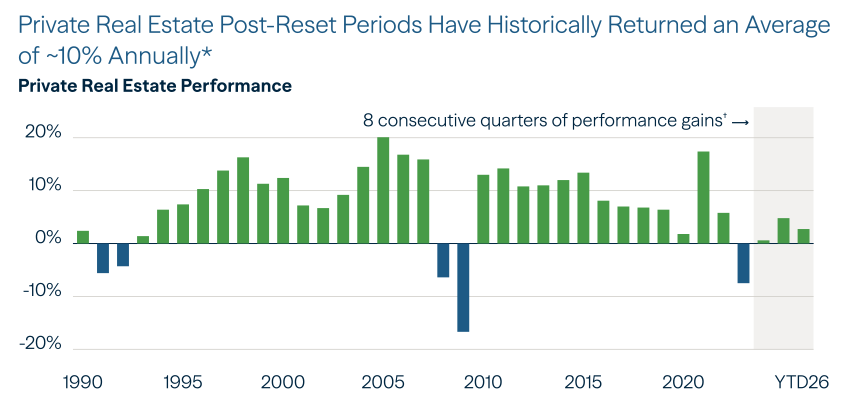
Real estate values recently underwent a significant correction across many sectors. Now the sector is recovering, and that recovery is accelerating. We have seen eight straight quarters of performance gains (see below), improving transaction volumes and more constructive financing markets. The first half of 2026 saw 4x more valuation improvement than in all of 2024.
Image
Past performance is not indicative of future results. There is no guarantee that investment objectives can be achieved.
An investor cannot invest in an index. While current conditions may present opportunities, real estate markets remain cyclical and subject to uncertainty, and outcomes will vary based on market conditions and investment selection.
* Based on certain market observations. The periods referenced are based on selected historical downturns and may not be representative of all market cycles. Private real estate represented by NCREIF Property Index and NFI-ODCE (U.S. indexes) as of June 30, 2026. YTD26 is year to date as of June 30, 2026.
† Represents annual return in the five years post-downturn.
Source: National Council of Real Estate Investment Fiduciaries (NCREIF). As of June 2026.
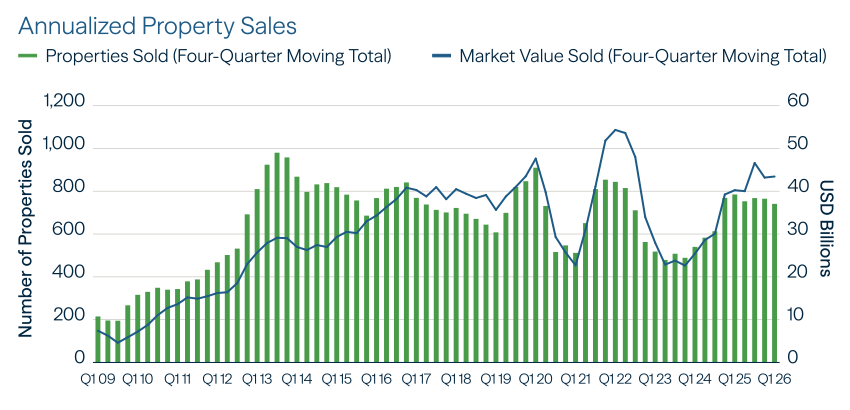
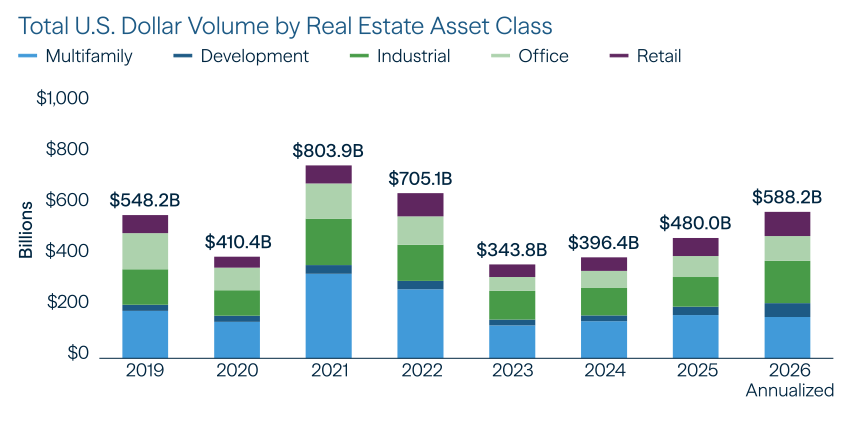
The U.S. real estate sales market recorded 3,426 transactions totaling $62.9 billion through the end of Q1 2026—a 7.71% increase in transactions and an 18% increase in dollar volume compared with Q1 2025.1 This sales volume is the clearest sign yet that the market has thawed (see below).
Image
Past performance is not indicative of future results.
Source: NCREIF. As of March 31, 2026.
Image
Past performance is not indicative of future results.
Source: NCREIF. As of March 31, 2026.
In past cycles after recovering, real estate has historically delivered strong performance for several years.
This suggests that we may still be in the early stages of a recovery, which can offer strong investment opportunities over time.
Five Factors That Support the Real Estate Opportunity
We believe there are five key factors that support the real estate opportunity:
- Strong secular demand drivers. The real estate market is supported by strong demand rooted in long-term themes such as property investments—e.g., to support the growth of AI, modernize logistics real estate and address ongoing housing shortages.
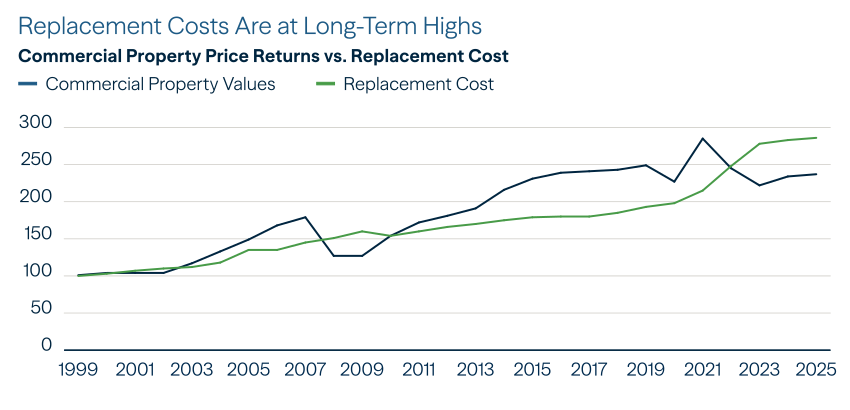
- Constrained new supply. Despite strong demand, construction starts are lagging across the globe, there is little new supply, and replacement costs are at historical highs (see below). Unlike past real estate recoveries that saw aggressive development, higher construction costs and elevated financing costs have significantly reduced development activity. All of this suggests that property values will remain elevated, benefiting investors.
Image
Past performance is not indicative of future results. There is no guarantee that investment objectives can be achieved. Indexes are unmanaged, and investors cannot directly invest in an index. Indexed to 100. Replacement cost represented by Zurich Replacement Value Cost Trends. These cost trends are published to assist in maintaining proper levels of insurable replacement costs for commercial and industrial properties. Replacement cost refers to the estimated cost to rebuild or replace a property or asset at current market prices.
Source: Cohen & Steers, Green Street, Zurich. As of September 2025.
- Stable capital markets environment. Interest rates are projected to be relatively stable over the near to mid term. That’s important, because lower interest-rate volatility can improve investor confidence and support real estate capital markets activity. A recovery in real estate capital markets is already underway, particularly with the aforementioned growth in sales volume. For investors, this environment may create opportunities for those with dry powder (or access to capital).
- Greater lending discipline. Along with more stability in the capital markets, we are seeing greater discipline. Previous real estate recoveries often relied heavily on leverage. Now we are seeing higher-quality underwriting along with more disciplined lending standards. As a result, value appreciation may come less from artificially low interest rates or overleveraged capital structures and more from genuine growth in property income and improving market fundamentals.
- Attractive valuations and entry yields. Despite the recent recovery, there is still room for improvement, as valuations are still 14% below their 2022 peak (see below), at a time when the cost to replace properties is much higher. In addition, entry yields are higher than they were in past cycles, providing opportunities to acquire assets that may increase in value during the hold period.
Image
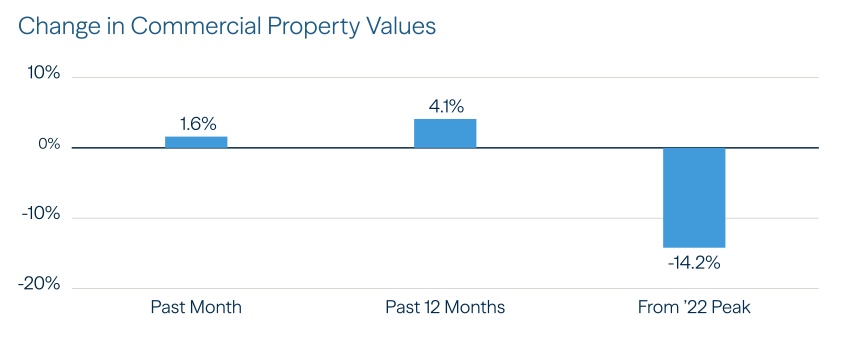
Source: Green Street. As of June 4, 2026.
Headwinds That May Be Tailwinds
While private real estate faces some headwinds, these come with silver linings. Caution is still warranted with regard to the asset class, particularly in the current environment of economic and geopolitical uncertainty. But this can help reduce competition for long-term capital to acquire assets, benefiting investors.
Moreover, while real estate fundamentals are solid and improving, pockets of dislocation remain.
A large number of real estate assets are facing capital or duration pressure. According to the Mortgage Bankers Association, approximately $875 billion of commercial and multifamily mortgage debt—about 17% of all outstanding commercial mortgages—is scheduled to mature in 2026, and could be facing recapitalization at higher interest rates. This creates opportunities for General Partner–led recaps and secondaries, and could benefit investors in those vehicles.
Bottom Line
Sentiment around the asset class is actually starting to catch up with the fundamentals, we believe, with the recovery accelerating. Given the geopolitical uncertainty and continued heightened inflation, we are seeing signs of renewed interest in hard assets and investments that offer stable income. Lenders with dry powder can still make deals before the crowd is expected to fully return.
Compared with recent equity market levels, real estate may offer relative value opportunities for investors. Moreover, it may offer strong diversification benefits and potential stability and ballast in a portfolio. While a confluence of factors suggest that this is a good time to invest in real estate, it is important to be selective and choose a manager that offers skill, scale, experience and operating advantages.
Read More in our Alts Quarterly Q3 2026.
END NOTES
1. Avison Young, as of March 31, 2026.
A WORD ABOUT RISK
As an asset class, private credit comprises a large variety of different debt instruments. While each has its own risk and return profile, private credit assets generally have increased risk of default, due to their typical opportunistic focus on companies with limited funding options, in comparison with their public equivalents. Because private credit usually involves lending to below-investment-grade or non-rated issuers, yield on private credit assets is increased in return for taking on increased risk.
Investments in real estate-related instruments may be affected by economic, legal or environmental factors that affect property values, rents or occupancies of real estate.
Infrastructure companies may be subject to a variety of factors that may adversely affect their business, including high interest costs, high leverage, regulation costs, economic slowdowns, surplus capacity, increased competition, lack of fuel availability and energy conservation policies.
Alternative investments often are speculative and include a high degree of risk. Investors could lose all or a substantial amount of their investment. High-yield bonds are subject to interest-rate risk. When interest rates rise, bond prices fall; generally, the longer a bond’s maturity, the more sensitive it is to this risk. Yields are subject to change with economic conditions. Yield is only one factor that should be considered when making an investment decision.
Investment opportunities related to artificial intelligence and emerging technologies involve significant risks including rapid technological change, regulatory uncertainty, market speculation, and the possibility that anticipated technological advances may not materialize as expected. AI-focused investments may be highly volatile and speculative in nature. Forecasts regarding AI adoption, data center demand, electricity consumption, and related infrastructure development are inherently uncertain and may not develop as anticipated.
The information in this publication is not and is not intended as investment advice, an indication of trading intent or holdings, or a prediction of investment performance. Diversification does not guarantee a profit or protect against loss. The views and information expressed herein are subject to change at any time. Brookfield disclaims any responsibility to update such views and/or information. This information is deemed to be from reliable sources; however, Brookfield does not warrant its completeness or accuracy.
The opinions expressed herein are the current opinions of Brookfield, including its subsidiaries and affiliates, and are subject to change without notice. Brookfield, including its subsidiaries and affiliates, assumes no responsibility to update such information or to notify clients of any changes. Any outlooks, forecasts or portfolio weightings presented herein are as of the date appearing on this material only and are also subject to change without notice. Past performance is not indicative of future performance, and the value of investments and the income derived from those investments can fluctuate.
Forward-Looking Statements
The information herein contains, includes or is based on forward-looking statements within the meaning of the federal securities laws, specifically Section 21E of the Securities Exchange Act of 1934, as amended, and Canadian securities laws. Forward-looking statements include all statements, other than statements of historical fact, that address future activities, events or developments, including, without limitation, business or investment strategy or measures to implement strategy, competitive strengths, goals, expansion and growth of our business, plans, prospects and references to our future success. You can identify these statements by the fact that they do not relate strictly to historical or current facts.
Words such as “anticipate,” “estimate,” “expect,” “project,” “intend,” “plan,” “believe” and other similar words are intended to identify these forward-looking statements. Forward-looking statements can be affected by inaccurate assumptions or by known or unknown risks and uncertainties. Many such factors will be important in determining our actual future results or outcomes. Consequently, no forward-looking statement can be guaranteed.
Our actual results or outcomes may vary materially. Given these uncertainties, you should not place undue reliance on these forward-looking statements. They are not intended to provide an overview of the terms applicable to any products sponsored by Brookfield Corporation and its affiliates (together, “Brookfield”). Information and views are subject to change without notice. Some of the information provided herein has been prepared based on Brookfield’s internal research, and certain information is based on various assumptions made by Brookfield, any of which may prove to be incorrect. Brookfield may not have verified (and disclaims any obligation to verify) the accuracy or completeness of any information included herein, including information that has been provided by third parties, and you cannot rely on Brookfield as having verified any of the information. The information provided herein reflects Brookfield’s perspectives and beliefs as of the date of this commentary.
Index Provider Disclaimer
The quoted indexes within this publication are unmanaged and cannot be purchased directly by investors. Index performance is shown for illustrative purposes only and does not predict or depict the performance of any investment. There may be material factors relevant to any such comparison, such as differences in volatility and also regulatory and legal restrictions between the indexes shown and any investment in a Brookfield strategy, composite or fund. Brookfield obtained all index data from third-party index sponsors and believes the data to be accurate; however, Brookfield makes no representation regarding its accuracy.
Brookfield does not own or participate in the construction or day-to-day management of the indexes referenced in this document.
The index information provided is for your information only and does not imply or predict that a Brookfield product will achieve similar results. This information is subject to change without notice. The indexes referenced in this document do not reflect any fees, expenses, sales charges or taxes. It is not possible to invest directly in an index. The index sponsors permit use of their indexes and related data on an “as is” basis, make no warranties regarding the same, do not guarantee the suitability, quality, accuracy, timeliness and/or completeness of their index or any data included in, related to or derived from it, and assume no liability in connection with the use of the foregoing. The index sponsors have no liability for any direct, indirect, special, incidental, punitive, consequential or other damages (including loss of profits). The index sponsors do not sponsor, endorse or recommend Brookfield or any of its products or services. Unless otherwise noted, all indexes are total-return indexes.
Key Terms and Index Definitions
Annualized Net Return is the geometric mean of the returns with respect to one year. It represents periodic returns rescaled to a period of one year.
Bloomberg Global Aggregate Index is a market-capitalization-weighted index comprising globally traded investment-grade bonds. The index includes government securities, mortgage-backed securities, asset-backed securities and corporate securities to simulate the universe of bonds in the market. The maturities of the bonds in the index are more than one year.
Bloomberg U.S. Corporate High Yield Bond Index measures the USD-denominated, high yield, fixed-rate corporate bond market.
Capitalization Rate (Cap Rate) is a real estate return metric used to estimate a property’s value based on its income potential. It is calculated by dividing the property’s net operating income by the present-day value of the property as indicated by prevailing market rates.
Cliffwater Direct Lending Index (CDLI) seeks to measure the unlevered, gross-of-fee performance of U.S. middle-market corporate loans, as represented by the asset-weighted performance of the underlying assets of business development companies (BDCs), including both exchange-traded and unlisted BDCs, subject to certain eligibility requirements.
Direct Lending Yield is represented by current yield, calculated as the most recent quarter’s interest payments divided by average assets over the quarter.
Dry Powder refers to committed but uninvested capital that private fund managers have available for future investment opportunities.
Enterprise Value to Earnings Before Interest, Taxes, Depreciation and Amortization (EV/EBITDA) is a valuation metric that compares a company’s total enterprise value to its EBITDA and is commonly used to assess relative valuation across companies and transactions.
FTSE EPRA Nareit Developed Real Estate Index is an unmanaged market-capitalization-weighted total-return index that consists of publicly traded equity REITs and listed property companies from developed markets.
Green Street Commercial Property Price Index (CPPI) is a time-series index published by Green Street, which tracks the value of U.S. commercial real estate properties. The index is based on transaction prices and appraisals of institutional-quality properties across major sectors, including office, industrial, retail and multifamily. It is widely used as a benchmark for changes in commercial property values over time.
ICE BofA U.S. High Yield Index tracks the performance of USD-denominated below-investment-grade corporate debt publicly issued in the U.S. domestic market.
Industrial Production: Manufacturing: Durable Goods: Semiconductor and Other Electronic Component Index measures the real output of all relevant establishments located in the United States, regardless of their ownership, but not those located in U.S. territories. The Federal Reserve’s monthly index of industrial production and the related capacity indexes and capacity utilization rates cover manufacturing, mining, and electric and gas utilities.
MSCI World Index is a free-float-adjusted market-capitalization-weighted index that is designed to measure the equity market performance of developed markets.
NCREIF Property Index (NPI) is a quarterly, unleveraged composite total return for private commercial real estate properties held for investment purposes only. All properties in the NPI have been acquired, at least in part, on behalf of tax-exempt institutional investors and held in a fiduciary environment.
Net Asset Value (NAV): The per share value of a mutual fund, found by subtracting the fund’s liabilities from its assets and dividing by the number of shares outstanding.
NFI-ODCE Index is an index of investment returns (gross of fees) of the largest private real estate funds pursuing a core investment strategy, which is typically characterized by low risk, low leverage (less than 40%), and stable properties diversified across the U.S.
Preqin Infrastructure Index captures in an index the return earned by investors on average in their private infrastructure portfolios, based on the actual amount of money invested in private capital partnerships. Each data point is individually calculated from the pool of closed-end funds for which comprehensive performance data is held, as of both the start and end of the quarter.
Preqin Private Equity Index captures in an index the return earned by investors on average in their private equity portfolios, based on the actual amount of money invested in private capital partnerships. Each data point is individually calculated from the pool of closed-end funds for which comprehensive performance data is held, as of both the start and end of the quarter.
Preqin Real Estate Index captures in an index the return earned by investors on average in their private real estate portfolios, based on the actual amount of money invested in private capital partnerships. Each data point is individually calculated from the pool of closed-end funds for which comprehensive performance data is held, as of both the start and end of the quarter.
Recapitalization is the process of changing the mix of debt and equity in an investment’s capital structure to optimize financing. In private equity, this may involve exchanging debt for equity or vice versa, such as selling shares to pay down debt. In real estate, recapitalization often means bringing in new investors to adjust the debt-equity balance. The main goals are to improve financial structure, manage debt, restructure ownership, or enhance underperforming assets.
Secondary Pricing refers to the price at which existing interests in private funds are bought and sold in the secondary market, often expressed as a percentage of the underlying fund’s net asset value (NAV).
S&P 500 Index is a market-cap-weighted equity index of 500 widely held, large-capitalization U.S. companies.
© 2026 Brookfield
BPW979628
