Market
Shall We Repeal the Laws of Economics – Part III
In Practice / General
The Allocation Evolution: The Emergence of Total Portfolio Approach Investing
Evolving traditional allocation frameworks through a more holistic approach
Financial markets look radically different today than at the turn of the 21st century. Private markets have seen tremendous growth, and more frequent macroeconomic regime shifts have undermined assumptions about long-term risk premia and stable asset-class correlations. That has led some institutional investors to explore new approaches to portfolio construction, such as the total portfolio approach (TPA).
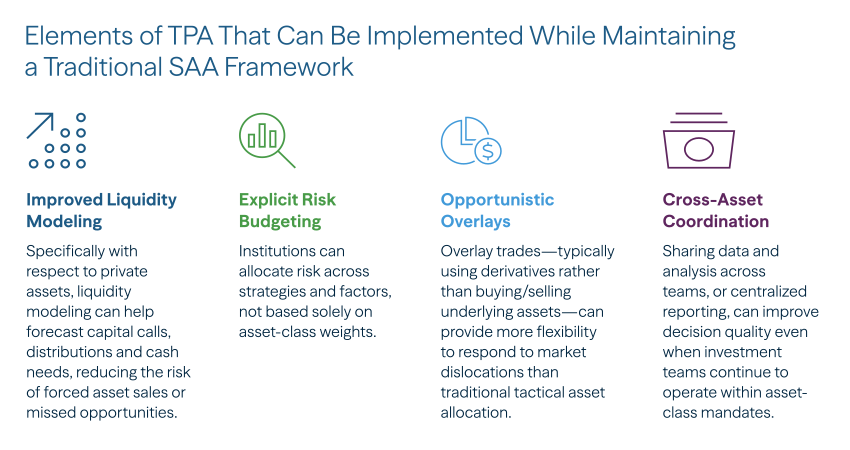
TPA considers portfolio construction holistically, focusing on total risk, return and liquidity across the portfolio. That contrasts with traditional strategic asset allocation (SAA), which builds portfolios around predefined asset class weights. A full transition to TPA can require significant changes to governance and processes, so many investors are instead incorporating some elements of TPA within their existing SAA framework, such as improved liquidity modeling and explicit risk budgeting.
We see three main practical considerations for institutions that are evaluating incorporating TPA:
- Choosing a risk-management framework based on the institution’s objectives and liabilities rather than asset-class volatilities or tracking error
- Managing liquidity as allocations to illiquid assets grow, ensuring they are of the appropriate size and composition
- Ensuring optimal manager selection, looking for strategic partners that can contribute to total portfolio outcomes and offer customized exposures and strategies
Ultimately, SAA and TPA are not mutually exclusive frameworks but endpoints on a spectrum. The most appropriate approach will depend on each institution’s objectives, liquidity profiles and governance structure.
Image