Market
Memos From Howard Marks: What’s Going on in Private Credit?Market / Infrastructure
Why Volatility Can Create Opportunities for Disciplined Infrastructure Investors
KEY POINTS
- Infrastructure has historically delivered stable performance with lower volatility than equities during major market disruptions
- Infrastructure’s features make it a compelling option for long-term, risk-adjusted returns in today’s macro environment
- Rapid growth in energy demand—driven by digitalization, AI and electrification—requires a diversified mix of energy sources, creating significant long-term investment opportunities
- Accessing opportunities requires expertise, global scale, local market knowledge and disciplined capital allocation
Historically Low Volatility
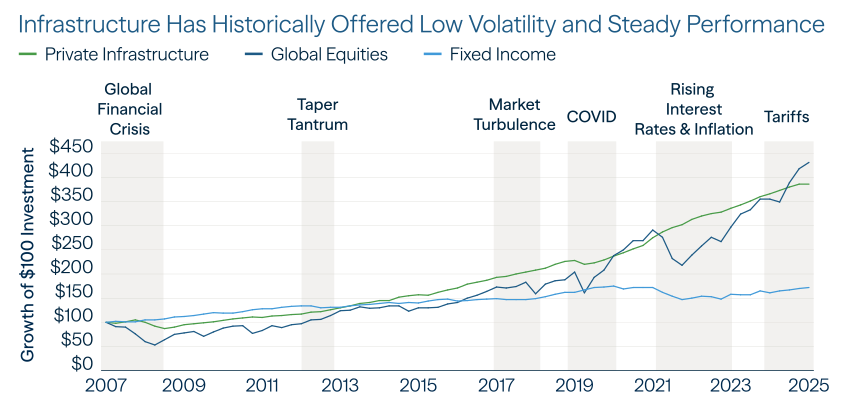
Recent history has seen its share of market volatility episodes—the 2008 global financial crisis, the 2013 “taper tantrum” and the COVID era in 2020, as well as other periods of market turbulence. Throughout, infrastructure investing has offered stability, steady performance and low volatility relative to broader equity markets (see below).
Infrastructure’s historically low volatility may be particularly attractive in the current environment, which has been defined by low real yields, persistent inflationary pressure and geopolitical turmoil. Investors with medium- to long-term risk-adjusted return targets may find it increasingly difficult to meet their performance goals in traditional asset classes.
Image
Performance data quoted represent past performance; past/prior performance does not guarantee, and is not indicative of, future results.
Private Infrastructure represented by Preqin Infrastructure Index, Global Equities by MSCI World Index and Fixed Income by Bloomberg Global Aggregate Bond Index. Preqin Infrastructure Index data as of September 30, 2025, due to latest data available. See disclosures for full index definitions. The indexes are unmanaged and cannot be purchased directly by investors. Index performance is shown for illustrative purposes only and does not predict or depict the performance of any investment. There may be limitations to the data provided given limited coverage, reporting lag and different valuation methodologies. Further, private infrastructure funds that are included in the index choose to self-report. Thus, the index is not representative of the entire private infrastructure universe and may be skewed toward those
funds that generally have higher performance. Over time, funds included and excluded based on performance may result in a “survivorship bias” that can result in a further misrepresentation of performance. Please see disclosures for additional information.
Source: Bloomberg, MSCI, Preqin. As of December 31, 2025, unless otherwise noted.
Infrastructure provides an alternative. We believe real assets stand out as an essential part of an investment portfolio in this evolving environment. Infrastructure investments can offer inflation-linked cash flows backed by hard assets that help protect real returns.
Capturing the Opportunity
Delivering the opportunities presented by infrastructure is not easy. It takes the right investment approach to identify promising infrastructure projects based on solid long-term fundamentals that can weather market disruptions.
In our view, a manager with sophisticated operational and development capabilities, as well as a diverse portfolio across technologies and geographies, should be well positioned to deliver attractive returns and long-term value.
To illustrate this point, let’s look at the energy sector. Energy is a fundamental building block for delivering economic and digital growth. It powers our day-to-day lives.
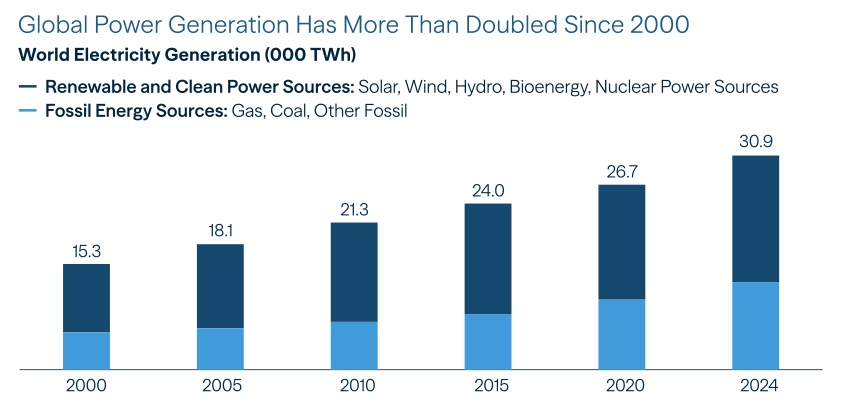
Electricity demand is surging, with global power generation more than doubling since 2000 (see below). This growth is driven by three main avenues: 1) digitalization, with the advent of artificial intelligence; 2) the growth of electrification for transportation; and 3) industrialization, in particular, industrial electrification.
Image
Performance data quoted represent past performance; past/prior performance does not guarantee, and is not indicative of, future results.
Private Infrastructure represented by Preqin Infrastructure Index, Global Equities by MSCI World Index and Fixed Income by Bloomberg Global Aggregate Bond Index. Preqin Infrastructure Index data as of September 30, 2025, due to latest data available. See disclosures for full index definitions. The indexes are unmanaged and cannot be purchased directly by investors. Index performance is shown for illustrative purposes only and does not predict or depict the performance of any investment. There may be limitations to the data provided given limited coverage, reporting lag and different valuation methodologies. Further, private infrastructure funds that are included in the index choose to self-report. Thus, the index is not representative of the entire private infrastructure universe and may be skewed toward those funds that generally have higher performance. Over time, funds included and excluded based on performance may result in a “survivorship bias” that can result in a further misrepresentation of performance. Please see disclosures for additional information.
Source: Bloomberg, MSCI, Preqin. As of December 31, 2025, unless otherwise noted.
No single energy technology can meet this growing demand. Renewable energy sources are among the lowest-cost solutions, but global power needs are increasing faster than renewable technology can be put in place. For governments and other entities buying power, a successful strategy will need to include a range of energy assets, including renewables, as well as battery storage solutions to store renewable energy, nuclear, natural gas, and additional alternative clean technologies.
Each technology individually can’t meet the growing demand, but the right mix of an “any and all” energy solution can offer a potential balance of cost and reliability for the grid. For investors, a diversified portfolio of energy assets can help hedge geopolitical and macroeconomic risk while capturing potential higher long-term returns.
For infrastructure investors, a disciplined approach to capital allocation is increasingly important, particularly with energy. Generating returns in such an environment requires a focus on securing long-term contracts backed by creditworthy counterparties and delivering technologies that stand to win on the fundamentals. These are, of course, the same rules that define success in other forms of infrastructure investing, but the energy sector demands unique discipline and expertise at a time of fast-paced demand, uncertainty and complexity in energy markets.
The Bottom Line
The demand we will witness over the next decade for infrastructure will be tremendous, but such a transformational market shift comes with the risk of potentially making poor capital-allocation decisions.
Mitigating that risk means maintaining a focus on the core principles of any good investment strategy. That includes maintaining a long-term horizon, exercising rigorous due diligence, and recognizing complexity at every stage. Moreover, sound risk management involves hedging project costs against revenues, locking in long-term contracts with strong counterparties and diversifying to be able to pivot to regions of the world with attractive risk-adjusted returns.
Capitalizing on opportunities in infrastructure requires more than capital. Equally if not more critical are the operational capabilities behind the investment. These include a global procurement team that can negotiate in different regions—and with scale—making it better positioned to protect against supply chain disruptions. Deep local expertise and strong operating teams are also essential to navigate regulatory frameworks, supply chain challenges and geopolitical uncertainty—and drive value, wherever the winds may shift.
Read More in our Alts Quarterly Q2 2026.
A WORD ABOUT RISK
As an asset class, private credit comprises a large variety of different debt instruments. While each has its own risk and return profile, private credit assets generally have increased risk of default, due to their typical opportunistic focus on companies with limited funding options, in comparison with their public equivalents. Because private credit usually involves lending to below-investment-grade or non-rated issuers, yield on private credit assets is increased in return for taking on increased risk.
Investments in real estate-related instruments may be affected by economic, legal or environmental factors that affect property values, rents or occupancies of real estate.
Infrastructure companies may be subject to a variety of factors that may adversely affect their business, including high interest costs, high leverage, regulation costs, economic slowdowns, surplus capacity, increased competition, lack of fuel availability and energy conservation policies.
Alternative investments often are speculative and include a high degree of risk. Investors could lose all or a substantial amount of their investment. High-yield bonds are subject to interest-rate risk. When interest rates rise, bond prices fall; generally, the longer a bond’s maturity, the more sensitive it is to this risk. Yields are subject to change with economic conditions. Yield is only one factor that should be considered when making an investment decision.
The information in this publication is not and is not intended as investment advice, an indication of trading intent or holdings, or a prediction of investment performance. Diversification does not guarantee a profit or protect against loss. The views and information expressed herein are subject to change at any time. Brookfield disclaims any responsibility to update such views and/or information. This information is deemed to be from reliable sources; however, Brookfield does not warrant its completeness or accuracy.
The opinions expressed herein are the current opinions of Brookfield, including its subsidiaries and affiliates, and are subject to change without notice. Brookfield, including its subsidiaries and affiliates, assumes no responsibility to update such information or to notify clients of any changes. Any outlooks, forecasts or portfolio weightings presented herein are as of the date appearing on this material only and are also subject to change without notice. Past performance is not indicative of future performance, and the value of investments and the income derived from those investments can fluctuate.
FORWARD-LOOKING STATEMENTS
The information herein contains, includes or is based on forward-looking statements within the meaning of the federal securities laws, specifically Section 21E of the Securities Exchange Act of 1934, as amended, and Canadian securities laws. Forward-looking statements include all statements, other than statements of historical fact, that address future activities, events or developments, including, without limitation, business or investment strategy or measures to implement strategy, competitive strengths, goals, expansion and growth of our business, plans, prospects and references to our future success. You can identify these statements by the fact that they do not relate strictly to historical or current facts.
Words such as “anticipate,” “estimate,” “expect,” “project,” “intend,” “plan,” “believe” and other similar words are intended to identify these forward-looking statements. Forward-looking statements can be affected by inaccurate assumptions or by known or unknown risks and uncertainties. Many such factors will be important in determining our actual future results or outcomes. Consequently, no forward-looking statement can be guaranteed.
Our actual results or outcomes may vary materially. Given these uncertainties, you should not place undue reliance on these forward-looking statements. They are not intended to provide an overview of the terms applicable to any products sponsored by Brookfield Corporation and its affiliates (together, “Brookfield”). Information and views are subject to change without notice. Some of the information provided herein has been prepared based on Brookfield’s internal research, and certain information is based on various assumptions made by Brookfield, any of which may prove to be incorrect. Brookfield may not have verified (and disclaims any obligation to verify) the accuracy or completeness of any information included herein, including information that has been provided by third parties, and you cannot rely on Brookfield as having verified any of the information. The information provided herein reflects Brookfield’s perspectives and beliefs as of the date of this commentary.
INDEX PROVIDER DISCLAIMER
The quoted indexes within this publication are unmanaged and cannot be purchased directly by investors. Index performance is shown for illustrative purposes only and does not predict or depict the performance of any investment. There may be material factors relevant to any such comparison, such as differences in volatility and also regulatory and legal restrictions between the indexes shown and any investment in a Brookfield strategy, composite or fund. Brookfield obtained all index data from third-party index sponsors and believes the data to be accurate; however, Brookfield makes no representation regarding its accuracy.
Brookfield does not own or participate in the construction or day-to-day management of the indexes referenced in this document. The index information provided is for your information only and does not imply or predict that a Brookfield product will achieve similar results. This information is subject to change without notice. The indexes referenced in this document do not reflect any fees, expenses, sales charges or taxes. It is not possible to invest directly in an index. The index sponsors permit use of their indexes and related data on an “as is” basis, make no warranties regarding the same, do not guarantee the suitability, quality, accuracy, timeliness and/or completeness of their index or any data included in, related to or derived from it, and assume no liability in connection with the use of the foregoing. The index sponsors have no liability for any direct, indirect, special, incidental, punitive, consequential or other damages (including loss of profits). The index sponsors do not sponsor, endorse or recommend Brookfield or any of its products or services. Unless otherwise noted, all indexes are total-return indexes.
KEY TERMS AND INDEX DEFINITIONS
Bloomberg Global Aggregate Index is a market-capitalization-weighted index comprising globally traded investment-grade bonds. The index includes government securities, mortgage-backed securities, asset-backed securities and corporate securities to simulate the universe of bonds in the market. The maturities of the bonds in the index are more than one year.
The Economic Policy Uncertainty Index for the United States reflects scaled frequency counts of articles in 10 leading newspapers (USA Today, the Miami Herald, the Chicago Tribune, the Washington Post, the Los Angeles Times, the Boston Globe, the San Francisco Chronicle, the Dallas Morning News, the Houston Chronicle and the Wall Street Journal). The construction of the modern portion of the index (1985–present) was based on monthly searches of each paper for terms related to economic policy uncertainty. Terms include “uncertainty” or “uncertain,” “economic” or “economy,” and one or more of the following: “Congress,” “legislation,” “White House,” “regulation,” “Federal Reserve,” or “deficit.”
Green Street Commercial Property Price Index (CPPI) is a time-series index published by Green Street, which tracks the value of U.S. commercial real estate properties. The index is based on transaction prices and appraisals of institutional-quality properties across major sectors, including office, industrial, retail and multifamily. It is widely used as a benchmark for changes in commercial property values over time.
Lincoln Senior Debt Index is a quarterly index that tracks the fair market value of 1,600 middle market, direct lending credit investments every quarter across approximately 175+ fund clients in the U.S. and Europe.
MSCI World Index is a free-float-adjusted market-capitalization-weighted index that is designed to measure the equity market performance of developed markets.
NFI-ODCE Index is an index of the investment returns (gross of fees) of the largest private real estate funds pursuing a core investment strategy that is typically characterized by low risk, low leverage (less than 40%), and stable properties diversified across the U.S.
Preqin Infrastructure Index captures in an index the return earned by investors on average in their private infrastructure portfolios, based on the actual amount of money invested in private capital partnerships. Each data point is individually calculated from the pool of closed-end funds for which comprehensive performance data is held, as of both the start and end of the quarter.
Preqin Private Equity Index captures in an index the return earned by investors on average in their private equity portfolios, based on the actual amount of money invested in private capital partnerships. Each data point is individually calculated from the pool of closed-end funds for which comprehensive performance data is held, as of both the start and end of the quarter.
Preqin Real Estate Index captures in an index the return earned by investors on average in their private real estate portfolios, based on the actual amount of money invested in private capital partnerships. Each data point is individually calculated from the pool of closed-end funds for which comprehensive performance data is held, as of both the start and end of the quarter.
S&P 500 Index is a market-cap-weighted equity index of 500 widely held, large-capitalization U.S. companies.
© 2026 Brookfield
ID BPW9343315
