Market
Memos From Howard Marks: What’s Going on in Private Credit?Market / Private Equity
Why Does Private Equity Matter to the Broader Economy?
KEY POINTS
- Private equity plays a surprising and underappreciated role in promoting economic activity and supporting employment.
- Private equity’s contribution to economic activity matters for investors. As a meaningful share of economic output and employment occurs outside public equity markets, private ownership has become a more prominent part of how investors and their portfolios engage with the real economy.
- Incorporating private equity into one’s portfolio can help boost diversification, income and long-term returns, and those benefits are rooted in the asset class’s relevance and importance to the economy.
Private Equity’s Surprising Economic Footprint
Too often private equity can generate negative press. Leveraged buyouts, cost-cutting measures including layoffs, and major transactions often grab the headlines.
In practice, however, most private equity ownership involves operating businesses that support everyday economic activity. For investors, this distinction matters—not just with regard to transactions, but also as a reflection of where economic activity increasingly resides.
Private equity supports a wide range of everyday experiences—such as servicing a car, completing a card payment or buying groceries. Each of these rely on operating businesses (many of which are privately owned) that enable commerce and services to function reliably behind the scenes (see below).
Image

For illustrative purposes only.
These companies may not be household names, but collectively they play a meaningful role in how goods and services are produced, distributed and delivered across the economy. Taken together, these businesses are integral to the functioning of the economy.
This helps explain why private equity has become so economically significant. Rather than existing solely as a financial mechanism, private equity ownership is often tied to companies with recurring demand, sizable workforces and deep integration into supply chains and service networks.
Economic Contribution and Employment
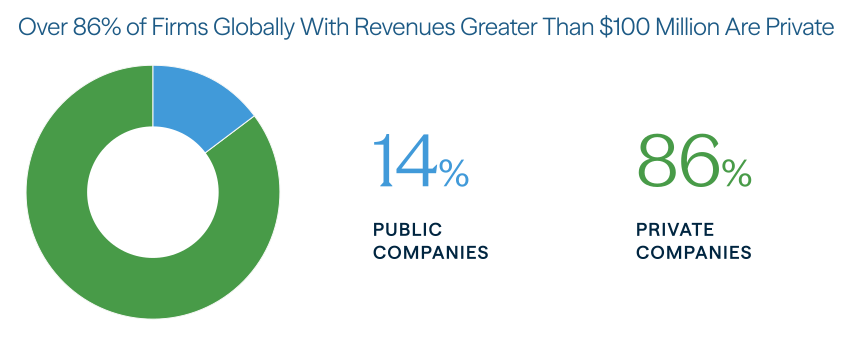
Globally, the number of publicly listed companies remains relatively limited at roughly 50,000 firms worldwide, according to World Bank data.11 By contrast, the vast majority of companies are privately held, whether backed by private capital or founder- and family-owned enterprises (see below). This imbalance underscores why private ownership structures play a central role in the modern economy and why so much economic activity takes place outside the public markets.
Image
Source: S&P Capital IQ, 2024.
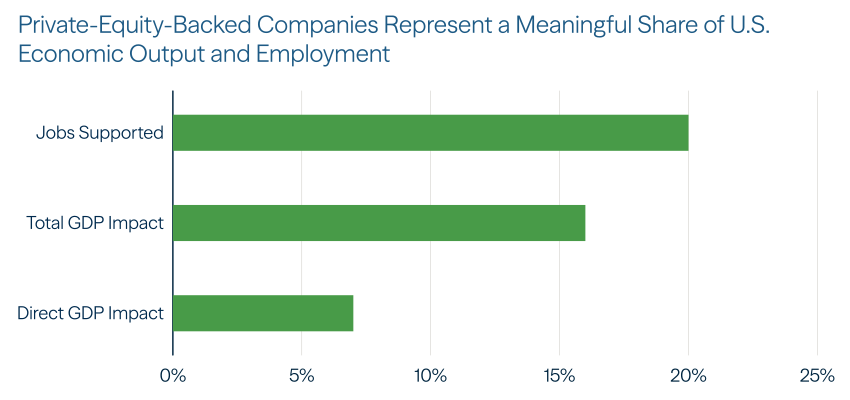
The economic role of these businesses is not abstract—it is measurable. In the U.S., private-equity-backed companies generated approximately $2 trillion in direct gross domestic product (GDP) in 2024, representing roughly 7% of total U.S. GDP. When indirect supplier activity and employee consumption are included, the broader private-equity-supported footprint totaled an estimated $4.7 trillion of economic output. That equates to close to 16% of U.S. GDP (see below).12
Image
Source: American Investment Council and EY, as of March 2025.
Employment data reinforce this scale. In 2024, private-equity-backed companies directly employed around 13 million workers, while total employment supported across supply chains and related economic activity reached approximately 33 million jobs when direct, indirect and induced effects are included— roughly one in five private-sector jobs.13
Beyond output and employment, the economic contribution of private-equity-backed companies extends to wages and public finances. On average, compensation at private-equity-backed companies is competitive relative to national benchmarks, reflecting the operating intensity and scale of many of these businesses.14 Collectively, their activity supports nearly $800 billion in federal, state and local tax revenue, helping fund schools, healthcare systems and core public infrastructure such as roads, transit and utilities.15
The Bottom Line
For investors, the context of private equity’s contribution to economic activity matters. As a meaningful share of economic output and employment occurs outside public equity markets, private ownership has become a more prominent part of how portfolios engage with the real economy. Incorporating private equity into a portfolio can help boost diversification, income and long-term returns, and those benefits are rooted in the asset class’s relevance and importance to the economy.
Read more in our Alts Quarterly Q1 2026.
ENDNOTES
11 World Federation of Exchanges, as of December 2024.
12 American Investment Council (AIC) and Ernst & Young (EY), as of March 2025.
13 AIC and EY, as of March 2025.
14 AIC and EY.
15 AIC and EY.
A WORD ABOUT RISK
As an asset class, private credit comprises a large variety of different debt instruments. While each has its own risk and return profile, private credit assets generally have increased risk of default, due o their typical opportunistic focus on companies with limited funding options, in comparison with their public equivalents. Because private credit usually involves lending to below-investment-grade credit assets is increased in return for taking on increased risk.
Investments in real estate-related instruments may be affected by economic, legal or environmental factors that affect property values, rents or occupancies of real estate.
Infrastructure companies may be subject to a variety of factors that may adversely affect their business, including high interest costs, high leverage, regulation costs, economic slowdown, surplus capacity, increased competition, lack of fuel availability and energy conservation policies.
Alternative investments often are speculative and include a high degree of risk. Investors could lose all or a substantial amount of their investment. High-yield bonds are subject to interest-rate risk. When interest rates rise, bond prices fall; generally, the longer a bond’s maturity, the more sensitive it is to this risk. Yields are subject to change with economic conditions. Yield is only one factor that should be considered when making an investment decision.
The information in this publication is not and is not intended as investment advice, an indication of trading intent or holdings, or a prediction of investment performance.
Diversification does not guarantee a profit or protect against loss. The views and information expressed herein are subject to change at any time. Brookfield disclaims any responsibility to update such views and/or information. This information is deemed to be from reliable sources; however, Brookfield does not warrant its completeness or accuracy.
The opinions expressed herein are the current opinions of Brookfield, including its subsidiaries and affiliates, and are subject to change without notice. Brookfield, including its subsidiaries and affiliates, assumes no responsibility to update such information or to notify clients of any changes. Any outlooks, forecasts or portfolio weightings presented herein are as of the date appearing on this material only and are also subject to change without notice.
Past performance is not indicative of future performance, and the value of investments and the income derived from those investments can fluctuate.
FORWARD-LOOKING STATEMENTS
The information herein contains, includes or is based on forward-looking statements within the meaning of the federal securities laws, specifically Section 21E of the Securities Exchange Act of 1934, as amended, and Canadian securities laws. Forward-looking statements include all statements, other than statements of historical fact, that address future activities, events or developments, including, without limitation, business or investment strategy or measures to implement strategy, competitive strengths, goals, expansion and growth of our business, plans, prospects and references to our future success. You can identify these statements by the fact that they do not relate strictly to historical or current facts.
Words such as “anticipate,” “estimate,” “expect,” “project,” “intend,” “plan,” “believe” and other similar words are intended to identify these forward-looking statements. Forward-looking statements can be affected by inaccurate assumptions or by known or unknown risks and uncertainties. Many such factors will be important in determining our actual future results or outcomes. Consequently, no forward-looking statement can be guaranteed.
Our actual results or outcomes may vary materially. Given these uncertainties, you should not place undue reliance on these forward-looking statements. They are not intended to provide an overview of the terms applicable to any products sponsored by Brookfield Corporation and its affiliates (together, “Brookfield”). Information and views are subject to change without notice. Some of the information provided herein has been prepared based on Brookfield’s internal research, and certain information is based on various assumptions made by Brookfield, any of which may prove to be incorrect. Brookfield may not have verified (and disclaims any obligation to verify) the accuracy or completeness of any information included herein, including information that has been provided by third parties, and you cannot rely on Brookfield as having verified any of the information. The information provided herein reflects Brookfield’s perspectives and beliefs as of the date of this commentary.
INDEX PROVIDER DISCLAIMER
The quoted indexes within this publication are unmanaged and cannot be purchased directly by investors. Index performance is shown for illustrative purposes only and does not predict or depict the performance of any investment. There may be material factors relevant to any such comparison, such as differences in volatility and also regulatory and legal restrictions between the indexes shown and any investment in a Brookfield strategy, composite or fund. Brookfield obtained all index data from third-party index sponsors and believes the data to be accurate; however, Brookfield makes no representation regarding its accuracy.
Brookfield does not own or participate in the construction or day-to-day management of the indexes referenced in this document. The index information provided is for your information only and does not imply or predict that a Brookfield product will achieve similar results. This information is subject to change without notice. The indexes referenced in this document do not reflect any fees, expenses, sales charges or taxes. It is not possible to invest directly in an index. The index sponsors permit use of their indexes and related data on an “as is” basis, make no warranties regarding the same, do not guarantee the suitability, quality, accuracy, timeliness and/or completeness of their index or any data included in, related to or derived therefrom, and assume no liability in connection with the use of the foregoing.
The index sponsors have no liability for any direct, indirect, special, incidental, punitive, consequential or other damages (including loss of profits). The index sponsors do not sponsor, endorse or recommend Brookfield or any of its products or services. Unless otherwise noted, all indexes are total-return indexes.
KEY TERMS AND INDEX DEFINITIONS
Bloomberg Global Aggregate Index is a market-capitalization-weighted index comprising globally traded investment-grade bonds. The index includes government securities, mortgage-backed securities, asset-backed securities and corporate securities to simulate the universe of bonds in the market. The maturities of the bonds in the index are more than one year.
Bloomberg U.S. Corporate High Yield Bond Index measures the USD-denominated, high-yield, fixed-rate corporate bond market. Securities are classified as high yield if the middle rating of Moody’s, Fitch and S&P is Ba1/BB+/BB+ or below.
Cliffwater Direct Lending Index (CDLI) seeks to measure the unlevered, gross-of-fee performance of U.S. middle-market corporate loans, as represented by the asset-weighted performance of the underlying assets of business development companies (BDCs), including both exchange-traded and unlisted BDCs, subject to certain eligibility requirements.
FTSE EPRA Nareit Developed Real Estate Index is an unmanaged market-capitalization- weighted total-return index that consists of publicly traded equity REITs and listed property companies from developed markets.
FTSE Global Core Infrastructure 50/50 Index gives participants an industry-defined interpretation of infrastructure and adjusts the exposure to certain infrastructure subsectors.The constituent weights are adjusted as part of the semi-annual review according to three broad industry sectors: 50% Utilities; 30% Transportation, including capping of 7.5% for railroads/railways; and a 20% mix of other sectors including pipelines, satellites and telecommunication towers. Company weights within each group are adjusted in proportion to their investable market capitalization.
Green Street Commercial Property Price Index (CPPI) is a time series index published by Green Street, which tracks the value of U.S. commercial real estate properties. The index is based on transaction prices and appraisals of institutional-quality properties across major sectors, including office, industrial, retail and multifamily. It is widely used as a benchmark for changes in commercial property values over time.
ICE BofA Single-B U.S. High Yield Index tracks the performance of USD-denominated below-investment-grade corporate debt publicly issued in the U.S. domestic market, including all securities with a given investment-grade rating of B.
ICE BofA U.S. Convertibles Index tracks the performance of convertible bonds in the U.S.
ICE BofA U.S. High Yield Constrained Index measures the performance of USD-denominated, non-investment-grade, fixed-rate, taxable corporate bonds.
J.P. Morgan CLO A Index is a subset of the J.P. Morgan CLO index that only tracks the A-rated CLOs.
J.P. Morgan CLO BB Index is a subset of the J.P. Morgan CLO index that only tracks the BB-rated CLOs.
J.P. Morgan CLO BBB Index is a subset of the J.P. Morgan CLO index that only tracks the BBB-rated CLOs.
MSCI ACWI ex USA captures large- and mid-cap representation across developed markets (DM) countries (excluding the U.S.) and emerging markets (EM) countries. The index covers approximately 85% of the global equity opportunity outside the U.S.
MSCI Emerging Markets Index is used to measure the financial performance of companies in fast-growing economies around the world. The index tracks mid-cap and large-cap stocks in 25 countries.
MSCI World Index is a free-float-adjusted market-capitalization-weighted index that is designed to measure the equity market performance of developed markets.
Preqin Infrastructure Index captures in an index the return earned by investors on average in their private infrastructure portfolios, based on the actual amount of money invested in private capital partnerships. Each data point is individually calculated from the pool of closed-end funds for which comprehensive performance data is held, as of both the start and end of the quarter.
Preqin Private Equity Index captures in an index the return earned by investors on average in their private equity portfolios, based on the actual amount of money invested in private capital partnerships. Each data point is individually calculated from the pool of closed-end funds for which comprehensive performance data is held, as of both the start and end of the quarter.
Preqin Real Estate Index captures in an index the return earned by investors on average in their private real estate portfolios, based on the actual amount of money invested in private capital partnerships. Each data point is individually calculated from the pool of closed-end funds for which comprehensive performance data is held, as of both the start and end of the quarter.
S&P 500 Index is a market-cap-weighted equity index of 500 widely held, large-capitalization U.S. companies.
S&P UBS Leveraged Loan Index measures the market-value-weighted performance of the investable universe of USD-denominated leveraged loans.
VERUS 2025-08 represents Verus Securitization Trust 2025-08’s issuance of an RMBS transaction backed by primarily newly originated first- and second-lien, fixed- and adjustable-rate residential mortgage loans, including mortgage loans with initial interest-only periods, to prime and nonprime borrowers.
© 2026 Brookfield Corporation
ID B886766
